
Sunflower and Leaf Filet Curtain Panel Crochet Pattern
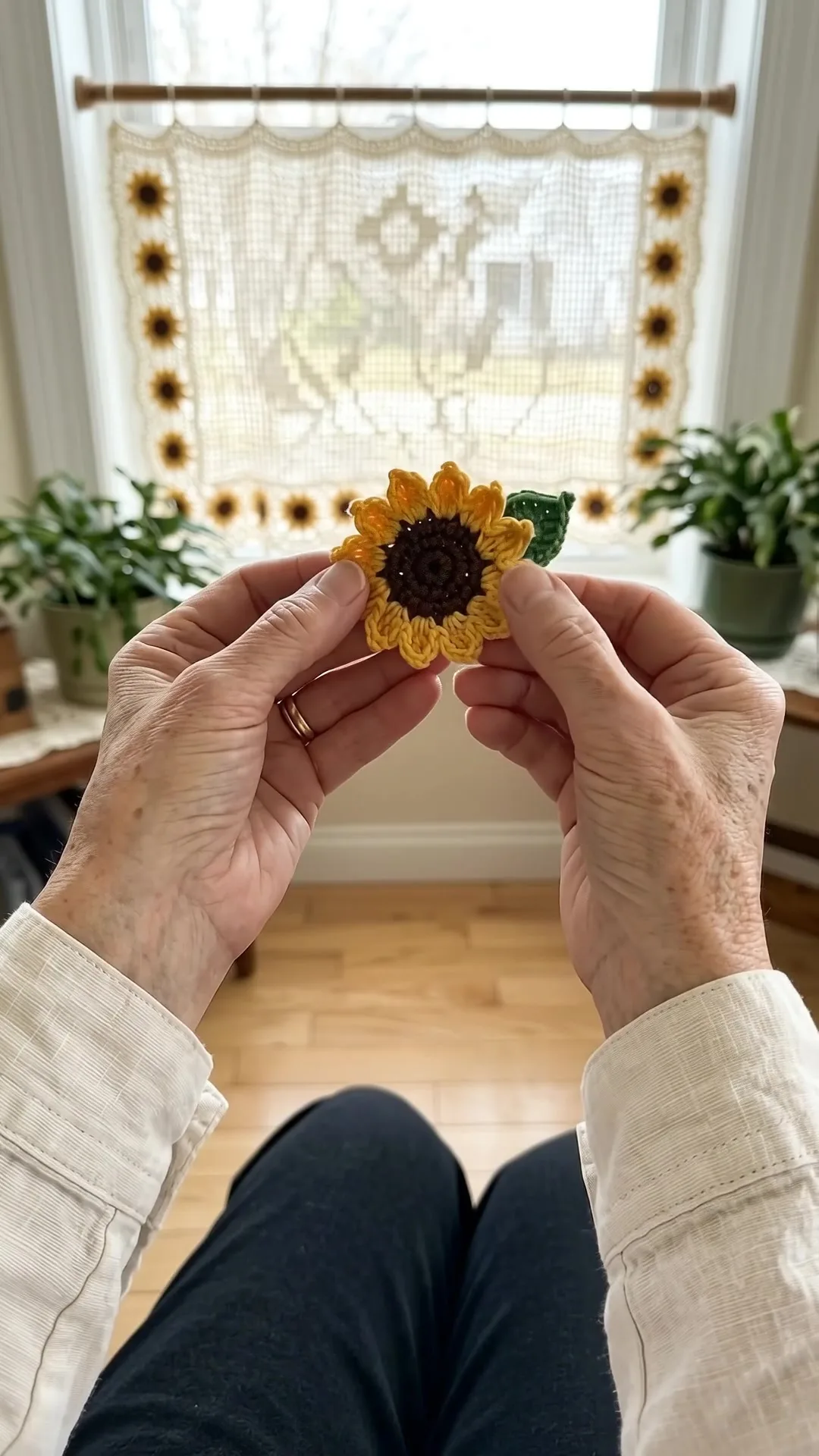
Uses chains, dc and filet blocks.
About 25 to 30 hours for one panel.
Sunflower yellow sunflowers glow when the light shines through.
About This Sunflower and Leaf Filet Curtain Panel Crochet Pattern Pattern
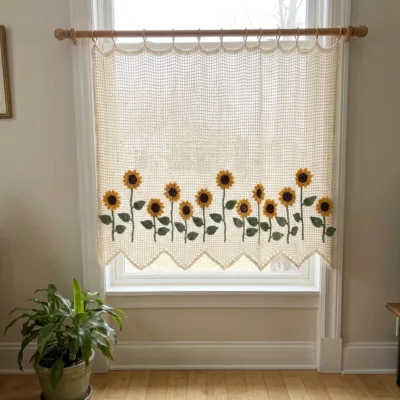
This curtain panel is an open cream filet mesh with a border of bright yellow sunflowers and green leaves rising from the bottom edge. The mesh lets sunlight pass through and throws soft lace shadows on the floor, while the sunflower border gives the panel a cheerful focal point. The panel measures about 28 inches wide and 45 inches long, and it hangs from a rod on chain loops, so there are no rings or clips to buy.
Filet crochet is one of the oldest and most beautiful forms of crochet. It is made of only a few stitches, mainly chain and double crochet, which form a grid of open spaces and solid blocks. The blocks make the picture and the spaces make the lace. Once you understand how a chart translates into blocks and spaces, you will be able to read any filet pattern.
What makes this curtain special
Sunflowers are the happiest flower in the garden, and they look wonderful in lace. The bright yellow petals and the dark brown centers stand out against the cream mesh, and the green leaves reach up the panel like stems. When the sun shines through the window, the shadow of the sunflowers falls on the floor and the whole room feels warm.
Filet curtains also have a long history in the home. They were made for kitchen windows, bedrooms and doors for generations, and they are making a lovely return in cottage and farmhouse decor. A handmade panel brings warmth to a window and shows off your skill in a way that is both practical and pretty.
Skill level and time
This pattern is rated intermediate. You need to be comfortable with chain, double crochet, slip stitch and reading a simple row guide. The curtain takes about 25 to 30 hours. Because filet is worked in straight rows, it is a good project for a long winter, and you can work on it in front of the television once you have the rhythm.
A relaxed way to plan the project:
- Week one: Make a small gauge swatch and work the foundation chain and the first rows of mesh.
- Weeks two and three: Work the mesh body, following the chart for the sunflower border.
- Week four: Make the sunflower motifs, work the hem and the rod loops, then block the panel.
Choosing your yarn
The pattern uses worsted weight (number four) cotton yarn. Cotton is the traditional choice for curtains because it is strong, washable and does not stretch under its own weight. It also takes starch well, which gives the mesh a crisp finish. Mercerized cotton adds a gentle sheen, but plain cotton gives a soft, rustic look that suits kitchens and cottage windows.
You need about 570 grams in total:
- Cream: about 400 grams for the mesh
- Sunflower yellow: about 80 grams for the petals
- Brown: about 30 grams for the centers
- Green: about 60 grams for the leaves and stems
Buy all of the cream yarn at once so the dye lots match, because the mesh is a large flat area and any difference in shade would show.
Tools you will need
A 3.5 mm (E) crochet hook is used in the pattern. You will also need a yarn needle, sharp scissors, blocking pins, a blocking mat or a clean towel, and a curtain rod for hanging. A tape measure and a small ruler are helpful for checking the gauge and the size of the panel as it grows.
Gauge and size
Four filet blocks should measure about 2 inches. Make a swatch of at least eight blocks across and eight rows, and measure it after pressing it flat. If your swatch is smaller, go up half a hook size. If it is larger, go down half a hook size. In filet crochet, tension matters because a loose mesh will droop and a tight mesh will pucker, so take the time to get the gauge right before you start the panel.
Understanding filet mesh
A filet grid is made from two kinds of squares. An open space is made of a chain of two and one double crochet, and a solid block is made of two double crochet in place of the chain. By filling certain spaces with blocks, you draw a picture in the mesh. This pattern uses an open mesh for the body and fills in blocks at the border to build the sunflower motifs.
The key to neat filet is to keep the double crochet the same height and the chains the same length. Keep a steady rhythm, and check that each row ends with the correct turning chain. The turning chain counts as a double crochet plus a chain space, so always work the last stitch of the row into the third chain of the turning chain of the previous row.
Working the mesh body
Begin with a long foundation chain and work the first row of spaces. Then turn and work the same row again and again, counting the spaces at the end of each row. Count often. A missing or extra space becomes a visible flaw in the lace, and it is much easier to fix after a few rows than after twenty. A stitch marker in the first space of every tenth row helps you keep your place.
The sunflower border
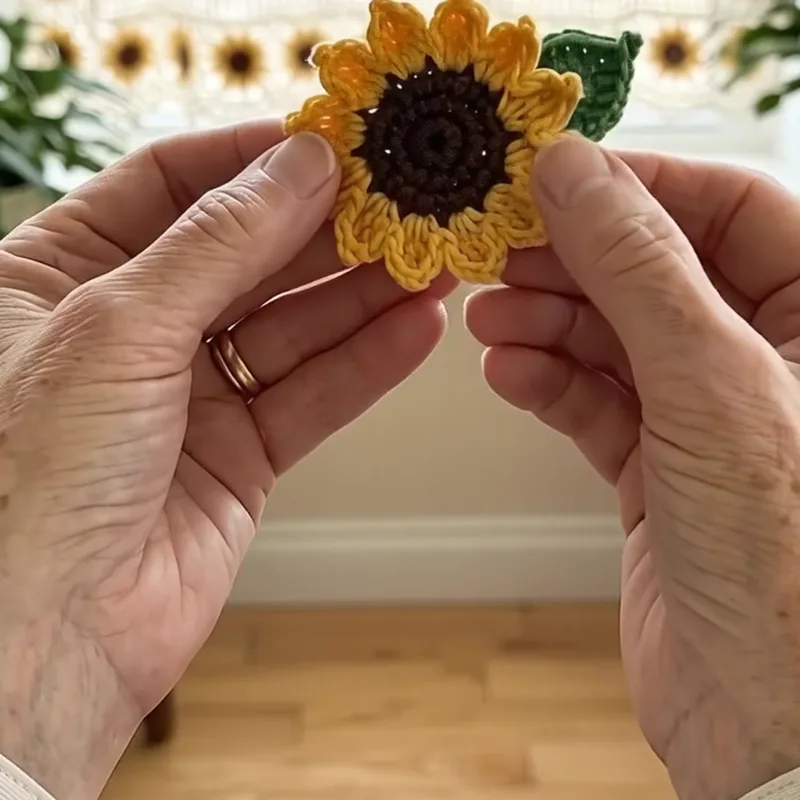
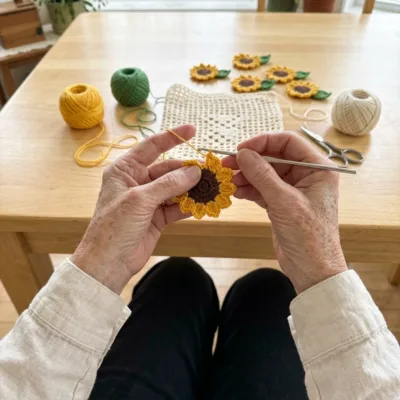
The border rises from the bottom of the panel. Follow the chart, filling the marked spaces with solid blocks. Work the blocks with a slightly tighter tension than the spaces so the picture stands out against the open mesh. The sunflower motifs themselves are small crocheted pieces that are sewn on after the mesh is complete, which gives the border a lovely raised texture.
The hem and rod loops
The hem is a scalloped edge made of groups of five double crochet separated by slip stitches. It gives the curtain a soft, finished bottom edge. Along the top, a row of chain loops forms the rod pocket. Space the loops evenly so the curtain hangs straight and the fullness is balanced. Slide the rod through the loops to test the fit before you block.
Blocking and starching
Blocking is the most important finishing step for a filet curtain. Pin the panel flat to a blocking mat, stretching it gently to the full size and squaring every corner. Spray with water or starch, let it dry completely and remove the pins. Blocking opens the mesh, makes the spaces perfectly square and lets the border stand out. A light starch gives the lace a crisp finish and helps it keep its shape between washes.
Troubleshooting common problems
If the edges of your panel look wavy, you are probably adding or losing a stitch at the turning chain. Check that every row ends with a double crochet in the third chain of the turning chain and that every row starts with a chain of five. If the panel is wider at the bottom than at the top, check your tension, because many crocheters relax as they work. Try a short break between sessions and compare each new row with the first.
If the mesh looks uneven, the chains between the double crochet are different lengths. Make a habit of using the same finger position on the hook for each chain. If the blocks look too big next to the spaces, work the double crochet of the blocks with a slightly smaller hook, or pull the yarn a little firmer on those stitches.
If the panel hangs crooked, check that the rod loops are evenly spaced and that you have the same number of loops on both halves. Blocking also fixes many problems, so pin the panel to the exact measurements and let it dry before you judge the result.
Caring for your filet curtain
Wash the curtain by hand in cool water with a mild soap, rinse thoroughly and press the water out with a towel without wringing. Re-block it to the original size and let it dry flat or hang it from the rod. A light starch after washing restores the crisp finish. Keep the panel away from direct, strong sunlight and from the heat of a stove, which can discolor cream cotton over time. For a kitchen window, a quick rinse every few months keeps grease from building up in the mesh.
Styling ideas for the window
A filet panel looks best when it is allowed to be seen. Hang it at the top of the window frame and let it fall freely, rather than pulling it to the side. Pair it with a simple wooden rod in a natural finish, or a thin black iron rod for a farmhouse feel. A few small plants on the sill in front of the lace make the whole window look like a picture. In a bathroom or a small bedroom, a single panel adds softness without blocking light, and at night the lace pattern shows up nicely when a lamp is on behind it.
Why You'll Love This Sunflower and Leaf Filet Curtain Panel Crochet Pattern Pattern
This curtain is easy to love. Bright sunflowers on soft cream lace feel warm, cheerful and a little nostalgic, like a farmhouse kitchen in summer. It softens a window without blocking the light, and it makes a kitchen, bathroom or small bedroom feel warm and welcoming.
It is also a project that teaches you a lot. You learn to read a chart, to keep an even tension and to finish a large flat piece, and you end up with a real piece of home decor that you made with your own hands.
Perfect for a sunny window
The open mesh lets in plenty of light while giving a little privacy and charm. It looks beautiful on a small kitchen window, a pantry door, a bathroom window or the glass panel of a front door. In the evening, the light from a lamp makes the lace pattern glow.
A lasting handmade gift
A handmade curtain is a special gift for a new home, a wedding or a family member who loves a cottage look. Because the panel is not very wide, you can make a pair for a larger window, or one panel as a wall hanging or table topper.
Durable and easy to care for
Cotton is practical for curtains. It can be washed by hand and starched, and it does not stretch when it hangs. If you keep the panel out of direct harsh sun, it will last for many years.
A relaxing project
Filet crochet is rhythmic and calming. After the first few rows you can work almost without looking, and the lace grows steadily. It is a lovely project for slow evenings and for crocheters who like to see a clear pattern develop row by row.
Switch Things Up
Once you understand the pattern, you can make it your own. Here are some ideas.
Change the colors
For a different look, make the sunflowers in orange and burgundy for an autumn version, or in blue and white for a cornflower look. A white or ecru mesh gives a more traditional look, while a soft sage or pale blue mesh gives a modern cottage feel.
Change the size
To make the panel wider, add more spaces to the foundation chain, three stitches for each extra space. To make it longer, add more rows of mesh before the border. Use these rough guides:
- Small window or door panel: 24 spaces wide and 30 rows, about 20 by 30 inches.
- Standard kitchen window: 36 spaces wide and 30 rows as written, about 28 by 45 inches.
- Wide window: 54 spaces wide, about 42 inches wide, or make two panels.
- Cafe curtain: 36 spaces wide and 20 rows, about 28 by 30 inches.
Change the border
You can replace the sunflower border with another design from a filet chart, such as flowers, birds, butterflies or a simple geometric pattern. Keep the same number of spaces across so it fits the panel.
Hang it differently
Instead of chain loops, you can sew small rings or ribbon ties along the top. A curtain clip system also works well, and lets you hang the panel from a thin wire or a decorative rod.
Use it as something else
A filet panel makes a lovely table runner, a wall hanging, a shelf liner or the front of a decorative pillow. Because it is made of a simple mesh, it can be adapted in many ways.
Materials Needed
— Main Fabric
— Tools Required
The Free Pattern
0% complete
— Foundation :
— Mesh Body :
— Sunflower Motif (Make 5) :
— Hem and Top Loops :
Assembly Instructions
- Weave in all ends.
- Block the panel flat with pins.
- Hang from the rod through the top loops.
Common Mistakes & How to Fix Them
Skipping the gauge swatch. In filet crochet, a small difference in tension changes the size of the panel a lot, so make a swatch first.
Miscounting spaces. A missing or extra space shows clearly in the lace, so count at the end of every row.
Pulling the chains tight. Tight chains make the mesh pucker, so keep them loose and even.
Forgetting the turning chain at the end of a row. The last stitch goes into the third chain of the turning chain, otherwise the edges become uneven.
Working the blocks too loosely. Loose blocks make the picture fuzzy, so work them with a slightly firmer tension.
Skipping blocking. Without blocking, the spaces stay uneven and the motifs may look crooked.
Hanging a panel that is too heavy. Use a sturdy rod and space the loops evenly so the weight is balanced.
Using a fuzzy yarn. Fuzzy yarn blurs the mesh, so choose a smooth cotton.
You Might Also Like
Important Notes
Make a gauge swatch of at least eight blocks across before you start the panel.
Use a smooth cotton yarn for the crispest lace.
Count the spaces at the end of each row.
Keep the same height for every double crochet.
Block the panel flat with pins, then starch lightly for a crisp finish.
Weave in your ends securely, splitting the strands so they do not work loose.
Hand wash gently in cool water, reshape and let the panel dry flat or hang it.
Keep the panel out of harsh direct sunlight to protect the color.
I hope this sunflower and leaf filet curtain panel brings light and charm to your window. Take your time with the mesh, count your spaces and enjoy watching the border grow. A good block makes all the difference at the end.
If you make it, I would love to see how it looks in your home. Share a photo and tell me where you hung it. Happy hooking!
Crochet Abbreviations
You Ask, We Answer
How big is the finished panel?
The panel measures about 28 inches wide and 45 inches long, worked on 36 spaces and about 30 rows of mesh plus the border and hem. You can change the width and the length by adding spaces and rows.
How long does it take?
Most people need about 25 to 30 hours. The mesh is quick once you have a rhythm, and the border motifs and finishing take a little longer.
Is this pattern good for beginners?
It is rated intermediate because of the chart and the need for even tension, but if you can chain and double crochet, you can learn filet. Make a swatch first to practice.
How much yarn do I need?
You need about 570 grams of worsted weight cotton yarn in total, split across the colors listed in the pattern. Buy the cream yarn all at once to match the dye lot.
What does a filet chart mean?
Each square on the chart is either an open space or a solid block. Open spaces are a chain of two and a double crochet, and solid blocks are two double crochet in place of the chain.
Can I use a different yarn weight?
Yes, but make a gauge swatch first and adjust the number of spaces to reach the width you want. A thinner yarn makes a more delicate lace and takes longer.
How do I wash and starch the curtain?
Hand wash in cool water with mild soap, rinse and press out the water in a towel. Dip in liquid starch or spray it, pin the panel flat to the right size and let it dry completely.
How do I hang the panel?
Slide a curtain rod through the chain loops along the top. Space the loops evenly so the panel hangs straight, and use a rod that is sturdy enough for cotton.
Can I make the panel wider?
Yes. Add three chains to the foundation for each extra space, and repeat the border chart across the width. Make sure the total number of spaces matches the chart.
Can I use different motifs?
You can swap the border for any filet chart with the same number of spaces. Always make a small swatch of the new chart to check the look before you commit.
Can I sell items made from this pattern?
Please check the terms on the pattern page. In general, items you make by hand are yours to enjoy, and a link back to the pattern is always appreciated when you share photos.
Success!
Thanks for subscribing — check your inbox for a welcome note.
Abbreviations
- ch — chain
- sc — single crochet
- sl st — slip stitch
- st — stitch
- dc — double crochet
- hdc — half double crochet