
Sage Blossom Tassel Curtain Crochet Pattern
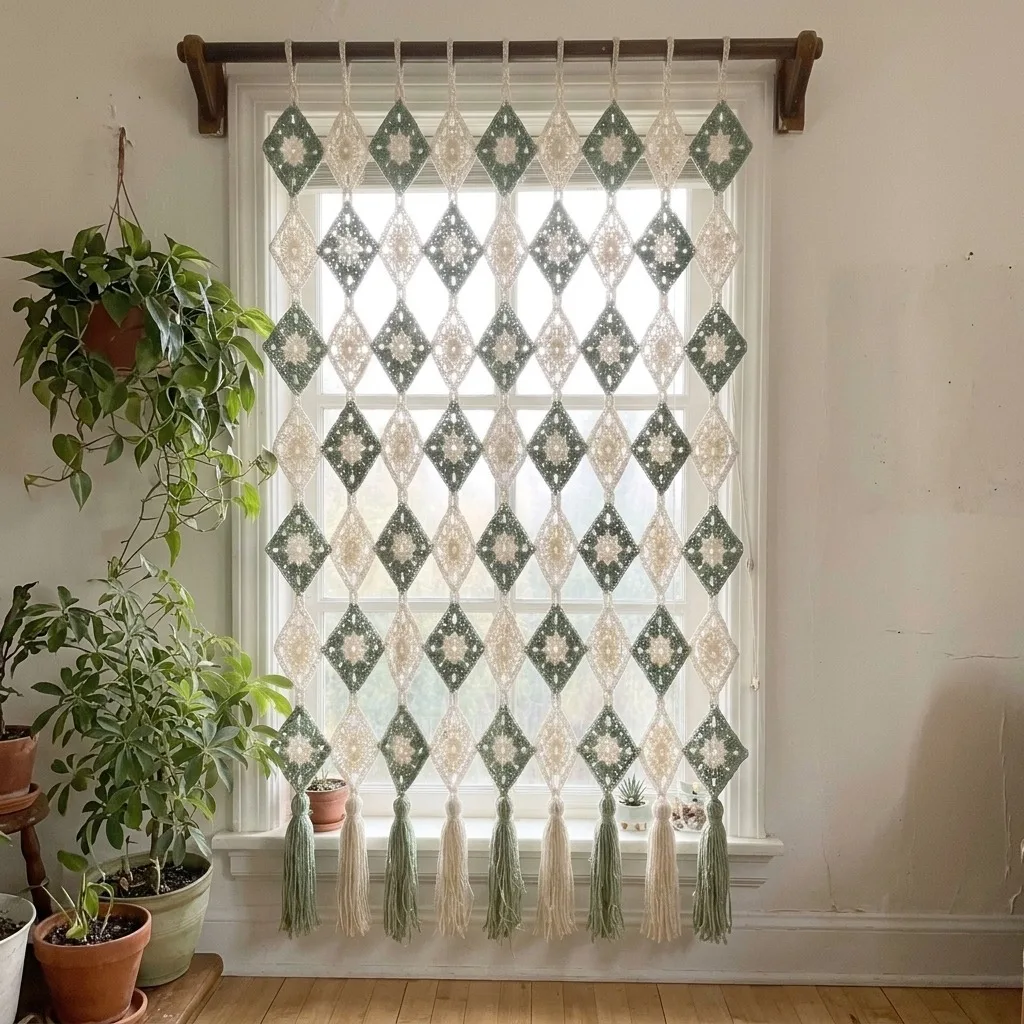
Uses dc, sc, chains and simple colorwork in joined motifs.
About 35 to 40 hours for a 34 by 66 inch curtain.
Sunlight glows through the open spaces.
About This Sage Blossom Tassel Curtain Crochet Pattern Pattern
The Sage Blossom Tassel Curtain is a handmade crochet curtain built from square flower motifs in soft sage green and soft cream. The motifs hang in columns, joined by short chain links, and every column ends in a long, soft tassel. It hangs from a wooden rod on simple yarn loops, and the sunlight shines through the open spaces between the motifs so that the whole window glows. The finished curtain measures about 34 inches wide and 66 inches long, including the tassels.
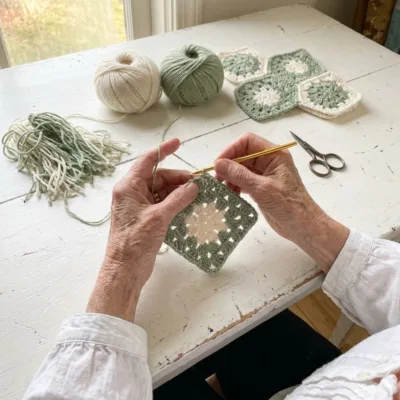
This is a curtain that people stop to look at. It looks complicated, but it is really one small flower motif repeated 35 times, then joined with chains. Once you have made the first three or four motifs, your hands know exactly what to do, and the project turns into a calm, steady rhythm that you can take anywhere. A single motif takes about an hour, so you can see progress every evening.
What makes this curtain special
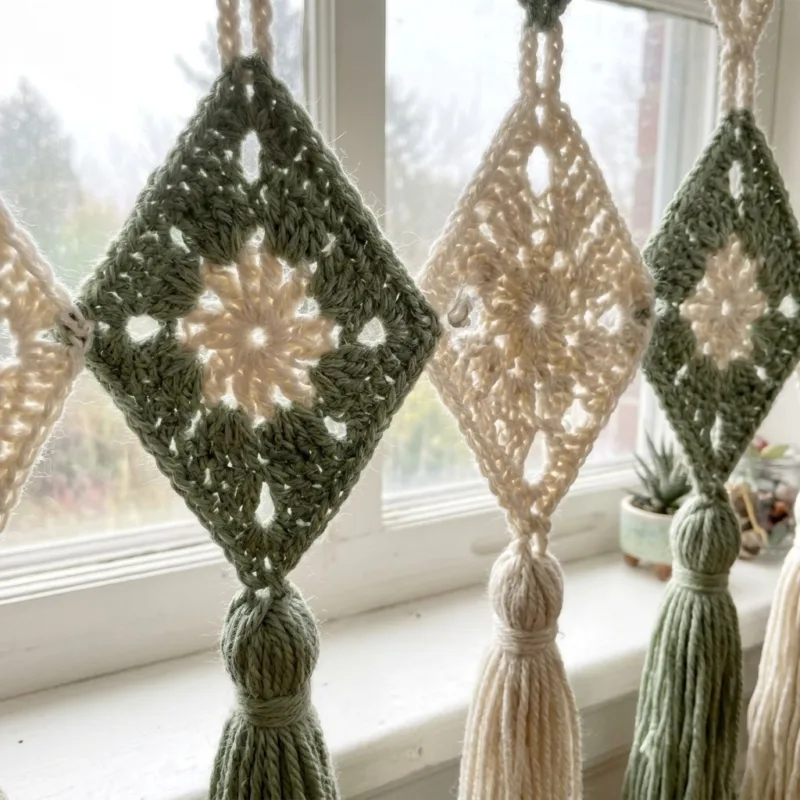
Most crochet curtains are lace panels worked in rows. This one is different, because it is built from separate motifs. Each flower has a cream center, a ring of sage green petals, a cream outer round and a sage green edging, which gives it a crisp look on the window. The chain links between the motifs are the secret of the design. They leave open spaces that let the daylight through, so the curtain filters the sun without blocking it, and it throws soft shadows of the flowers on the wall and the floor.
The tassels finish the design. Each one is made from sage green and cream strands tied together, and they sway gently when a window is open. They give the curtain weight, so the columns hang straight, and they add a soft, romantic finish to the bottom edge.
Skill level and time
This pattern is rated intermediate. You need to be comfortable with the magic ring, double crochet, single crochet, chains and changing colors at the end of a round. The squaring of the motif is done with simple corner groups, so there is nothing tricky about the shaping. The curtain takes about 35 to 40 hours in total. Because the motifs are small and portable, the project suits busy crocheters who work in short sessions.
A relaxed way to plan the project:
- Weeks one and two: Make a test motif, check the size and then make 17 more, so you have half of the motifs.
- Weeks three and four: Make the remaining 17 motifs and block them all flat.
- Week five: Join the motifs into five columns with the chain links, then make the tassels and the rod loops.
Choosing your yarn
The pattern uses worsted weight (number four) cotton yarn. Cotton is the best choice for a curtain because it is strong, washable and does not stretch out of shape under its own weight. A cotton with a matte finish gives the soft, rustic look of the curtain, and it takes blocking well, so the corners of each square stay sharp. Avoid very slippery or very fuzzy yarns, because a slippery yarn makes the chain links stretch and a fuzzy yarn hides the stitch definition of the flower.
You need about 750 grams of yarn in total:
- Sage green: about 430 grams (about 860 yards) for the petals, the edging, the chain links, the tassels and the rod loops
- Cream: about 320 grams (about 640 yards) for the centers, the outer rounds and the tassels
Buy all of each color at once so the dye lots match. In a curtain with this many repeated motifs, even a small difference in shade would show from one column to the next.
Tools you will need
A 4.0 mm (G) crochet hook is used for the whole pattern. You will also need a yarn needle, sharp scissors, stitch markers, blocking pins, a blocking mat or a clean towel and a ruler. A wooden curtain rod about 40 inches long is used for hanging, and a small piece of cardboard cut to 10 inches is handy for measuring the tassels.
Gauge and size
The first three rounds of the motif should measure about 3 inches across. Make a test motif and measure it after blocking. The finished motif should be about 6 inches square. If it comes out smaller, go up half a hook size. If it is larger, go down half a hook size. A motif curtain depends on consistent size, because motifs of different sizes make the columns uneven and the joins fall in the wrong places.
Making the flower motif
The motif starts with a magic ring and twelve double crochet in cream. This small center is the heart of the flower. The second round, in sage green, doubles the stitches to make the petals, and the third round starts the squaring with four corner groups. The cream round then outlines the flower, and a final round of sage green single crochet gives a firm, neat edge. Work each round with the right side facing you and pull the corners tight so they stay sharp.
Weave in the tails as you go. With 35 motifs, it is a big job to weave in 140 ends at the end, so after each motif, spend one minute to bury the two ends of the color change. Your future self will thank you.
Joining with chain links
This is the most distinctive part of the curtain. Instead of sewing the motifs together, you join them with two chain links between each pair, each link made of twelve chains. The chains are attached at the fourth single crochet from each corner, so they hang parallel to each other and form a little ladder between the squares. Lay the motifs out on a table first, with about two inches of space between them, and pin the attachment stitches so every link is in the same place.
A common question is how tight the chains should be. They should be firm enough to hold the weight of the motifs below, but loose enough to leave a small curve. If you work the chains too tight, the columns will pull in and become narrow at the links. If they are too loose, the curtain will droop. Twelve chains in worsted cotton measure about two inches when relaxed, which is exactly what the design needs.
The tassels
The tassels are made from forty-eight strands each, twenty-four in sage green and twenty-four in cream. Cut the strands long, about twenty-two inches, so that they are about ten inches long after folding and trimming. A piece of cardboard makes the cutting quick, and keeps all five tassels the same length. Tie the bundle tightly at the top, attach it to the corner of the last motif and wrap the neck with sage green yarn to finish the tassel.
Hanging the curtain
The rod loops are chains of fourteen, attached to the top corners of the first motif of each column. Slide the rod through the loops and hang the curtain. Adjust the columns so there is about one inch of space between them. If the columns twist, turn them gently until the motifs face forward.
Blocking and finishing
Blocking is the most important finishing step. Pin each motif to a mat at six inches square, spray it with water, let it dry completely and unpin it. Blocked motifs lie flat and keep their square shape, so the finished columns hang straight. After joining, steam the columns lightly while hanging, holding the steamer a few inches away, and let the cotton relax before you trim the tassels.
Why You'll Love This Sage Blossom Tassel Curtain Crochet Pattern Pattern
This curtain is easy to love. Sage green and soft cream is a color pairing that feels fresh and calm, and the flowers and tassels give it a handmade charm that no store-bought curtain can match. It softens a window without blocking the light, and it makes a kitchen, a reading nook or a small bedroom feel warm and welcoming.
It is also a project that teaches you a lot. You practice the magic ring, you learn to square a round motif, you practice changing colors cleanly and you finish with a real piece of home decor that you made with your own hands.
Light that glows through
Because of the open spaces between the motifs, the sunlight passes through the curtain and lights up the flowers from behind. In the morning, the sage looks soft and misty. In the evening, a lamp behind the curtain makes the pattern glow from the outside too, so the window looks pretty from the street.
A project you can take anywhere
A single motif is small enough to carry in a purse, so you can crochet in the car, in the waiting room or in front of the television. When you finish a motif, you can put it in a basket and start another one without any planning. This makes the project suit busy people who only crochet in short sessions.
A lasting handmade gift
A handmade curtain is a special gift for a new home, a wedding or a family member who loves a cottage look. You can also make just one column, with five motifs and a tassel, as a wall hanging or a door decoration for a smaller present.
Durable and easy to care for
Cotton is practical for curtains. It can be washed by hand and reshaped, and it does not stretch when it hangs. If you keep the curtain out of the harshest direct sun, the sage will stay bright for many years.
Switch Things Up
Once you understand the pattern, you can make it your own. Here are some ideas.
Change the colors
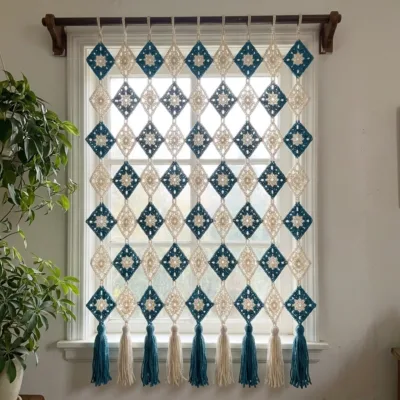
Sage and cream is a fresh pairing, but the pattern works in many color pairs. Red and white looks classic and cheerful, blue and cream feels like a seaside cottage, dusty blue and white looks calm, pink and white is soft and sweet, and white with golden details is elegant for a bedroom. Choose two colors with good contrast, so the petals stand out from the center and the outer round.
Change the size
To make the curtain wider, add more columns. To make it longer, add more motifs to each column. Use these rough guides:
- Small window or door: 3 columns of 5 motifs, about 20 by 46 inches.
- Standard window: 5 columns of 7 motifs as written, about 34 by 66 inches.
- Wide window: 7 columns of 7 motifs, about 48 by 66 inches.
- Cafe curtain: 5 columns of 4 motifs, about 34 by 42 inches.
Change the tassels
For a more dramatic look, make the tassels longer, up to 14 inches, or make them all in sage green. For a softer look, use only cream. You can also make two small tassels per column instead of one large one.
Change the motif
If you do not like the squared flower, you can use a round motif or a hexagon. Keep the same size, about six inches, so the chain links still fit.
Use it as something else
One column makes a lovely wall hanging. A few motifs joined with chain links make a charming garland for a mantel. A single motif works as a coaster or a square for a blanket.
Materials Needed
— Main Fabric
— Tools Required
The Free Pattern
0% complete
— Flower Motif (Make 35) :
— Chain Links and Columns (Make 5 Columns) :
— Tassels (Make 5) :
— Counts and Size :
— Rod Loops :
Assembly Instructions
- Block all 35 motifs flat to 6 inches square and let them dry completely.
- Join the motifs into 5 columns of 7 with the chain links.
- Make and attach the 5 tassels to the bottom corner of the last motif in each column.
- Add the rod loops to the top of each column.
- Weave in all ends securely, slide the rod through the loops and hang the curtain.
Common Mistakes & How to Fix Them
Skipping the test motif. A small difference in size is multiplied by 35, so make one motif first and check that it measures 6 inches after blocking.
Pulling the corners loose. Loose corners round off the square, so work the corner groups firmly and block hard.
Making chain links of different lengths. Uneven links make the columns wavy, so count every chain and check them against a ruler.
Skipping the blocking. Unblocked motifs curl and the curtain looks uneven, so block every motif to the exact size.
Using too little yarn for the tassels. Thin tassels look sparse, so use all 48 strands.
Leaving all the ends to the end. With 35 motifs, it is a big job to weave in 140 ends, so weave them in as you go.
Attaching the loops unevenly. A crooked top makes the curtain twist, so measure the loops before you fasten them.
Using a fuzzy or slippery yarn. Choose a smooth, matte cotton for neat motifs and firm chains.

You Might Also Like
Important Notes
Make a test motif and check that it measures 6 inches square after blocking.
Use a smooth cotton yarn for the best stitch definition.
Weave in the ends of each motif as you finish it.
Count the chains of every link, 12 for each one.
Block every motif flat before joining.
Lay out the whole column on a table before attaching the links.
Hand wash gently in cool water, reshape and let the curtain dry flat or hang it.
Keep the curtain out of harsh direct sunlight to protect the color.
I hope this sage blossom tassel curtain brings light and charm to your window. Take your time with the motifs, enjoy the steady rhythm and do not rush the blocking. When you hang it for the first time and the sun shines through, you will see how much beauty a small flower can make.
If you make it, I would love to see how it looks in your home. Share a photo and tell me where you hung it. Happy hooking!
Crochet Abbreviations
You Ask, We Answer
How big is the finished curtain?
The curtain measures about 34 inches wide and 66 inches long including the tassels, made of 5 columns of 7 motifs. You can change the width and length by adding or removing columns and motifs.
How long does it take?
Most people need about 35 to 40 hours. Each motif takes about an hour, and the joining, tassels and rod loops take about 5 hours.
Is this pattern good for beginners?
It is rated intermediate because of the magic ring and the color changes, but if you can chain and double crochet, you can make it. The repeated motif is a good way to build skill.
How much yarn do I need?
You need about 430 grams of sage green and 320 grams of cream worsted weight cotton yarn, about 750 grams in total.
How do I wash the curtain?
Hand wash in cool water with a mild soap, press out the water in a towel, reshape the motifs and let the curtain dry flat or hang it from the rod.
How do I hang it?
Slide a wooden rod through the 5 yarn loops at the top of the columns. Use a sturdy rod that can carry the weight of cotton.
Can I use a different color?
Yes. Any two colors with good contrast work well. Red and white, blue and cream, dusty blue and white and pink and white are all popular.
Can I make it shorter?
Yes. Use fewer motifs in each column. Five motifs per column makes a curtain about 50 inches long with the tassels.
Can I use a different yarn weight?
You can, but make a test motif and adjust the number of motifs to reach the size you want. A thinner yarn makes a lighter curtain and takes longer.
Do the tassels need to be exactly the same?
They should be the same length so the bottom edge looks neat. Use a piece of cardboard cut to ten inches as a guide when you trim.
Success!
Thanks for subscribing — check your inbox for a welcome note.
Abbreviations
- ch — chain
- sc — single crochet
- sl st — slip stitch
- st — stitch
- dc — double crochet